
Sunday Worship 19 April | Deepening Prayer

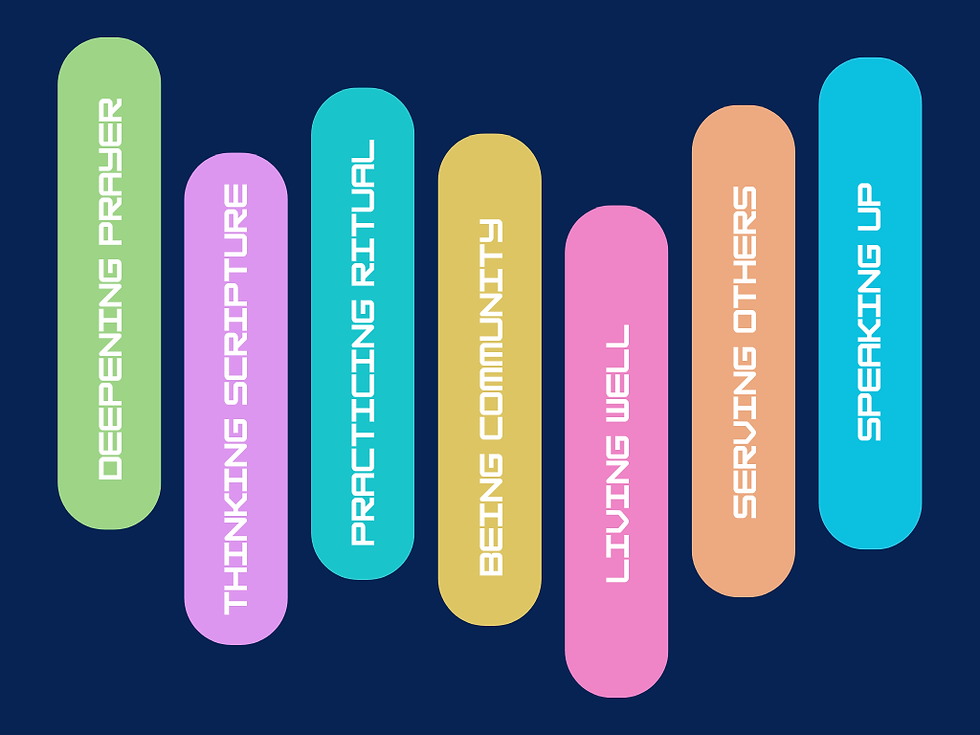
From now until the start of my sabbatical at the end of June, we are going to be looking at some holy habits, or spiritual practices that can help us grow in our connection to God and in our engagement with the world. These are deepening prayer, thinking scripture, practising ritual, being community, living well, serving others and speaking up.
I think these are practices that are good for all of us, but we will each respond to them differently, and some of them will resonate with us more than others, so think of this less as a comprehensive guide and more as a series of pointers into landscapes you might like to explore.
At house group on Wednesday evening, a few us had a go at finding our spiritual pathways. The general consensus was that some of the questions were a little odd and so some of the results were a little off, so I’m not going to suggest that we repeat the exercise together this morning, but it was interesting to reflect on the different habits and practices that connect us to God and engage us with the world, and so I do want to outline the pathways we looked at and give you a few moments to think about which you are most drawn to.
So here they are, with a few slight tweaks:
Activism | taking action to right a wrong or initiate a change
Contemplation | enjoying prayer and meditation
Nature | experiencing God through our senses and the natural world
Intellect | pursuing knowledge and wisdom
Relationships | connecting with others
Service | completing meaningful tasks on behalf of others
Worship | participating in creative expression or shared ritual
Are there one or more that particular describe you? What kind of habits or practices guide you on this pathway? Feel free to reflect quietly or with those around you.
This wasn’t intentional, but the seven holy habits I have chosen to look at more or less correspond to the seven spiritual pathways, although we will come to them in a different order. So depending on which pathway or pathways you follow most closely, some of the habits will come more naturally than others. I would encourage you to lean in to your natural spirituality, because God wants to connect with you as you are not force you into another mould, but also to be open to exploring some of the habits from other pathways, because challenge can enrich us in surprising ways.
This morning we are going to start with the holy habit of deepening prayer. As I was preparing this order of service, I was thinking about what reading we might hear, and it occurred to me that scripture prays far more than it talks about prayer, and so we are going to follow in that same pattern.
---
How long, Lord? Will you forget me forever?
How long will you hide your face from me?
How long must I wrestle with my thoughts
and day after day have sorrow in my heart?
How long will my enemy triumph over me?
Look on me and answer, Lord my God.
- Psalm 13
I have always loved liturgical prayer, but I think it can train us to be a little politer than we need to be, so we’re going to begin with a prayer exercise I have borrowed from Kate Bowler. Scripture is full of people raging against God, secure in the knowledge that God is a safe place to take their anger and their lament, and so this morning I want you to imagine that the kingdom of God has a complaints department. What complaint would you file today? Something that has gone wrong in your own life? Something that grieves you in the world?
Kate Bowler suggest the following advice:
Start with what you repeat. Think about a story you end up retelling.
If it wasn’t important, you probably wouldn’t keep telling it.
Begin with the facts and use full sentences. God can handle specificity. (This is for your eyes only.)
Avoid putting a spin on it. Don’t worry about feeling like a good person. This is not about that.
Don't expect a resolution. Some things will be fixed but some things can't. This is a complaint not a request for change.
Feel free to use humour. The psalms do.
Trust that honesty is not disobedience. It is often the beginning of faith. And if it still feels odd, let’s remember Jesus had some complaints about heading to the cross.
---
Hear me, Lord, and answer me,
for I am poor and needy.
Guard my life, for I am faithful to you;
save your servant who trusts in you.
You are my God; have mercy on me, Lord,
for I call to you all day long.
Bring joy to your servant, Lord,
for I put my trust in you.
- Psalm 86
Scripture encourages us to come to God with all sorts of petitions. I do however want to caution against treating this kind of prayer as a list of demands, and setting ourselves up for disappointment if they are not answered in the way we hope. I believe that God is involved in the world but I do not believe that God controls the world, and so God cannot bring about everything we ask for, even if it is something that God wants too. I also think we need to guard against any sense that we are moving things from our to do list onto God’s. To quote the late Pope Francis, “You pray for the hungry, then you feed them. That is how prayer works”. When we ask God for something, we should be opening ourselves to hearing from God how we can answer that need.
There are many ways we can engage in petitionary prayer. Offering to hold a friend before God, praying in response to a news report, crying out ‘Lord have mercy’ as we scroll through our social media feeds. This morning we are going to pray using our hands, because we are embodied creatures and it is good to use our whole selves. Our thumb is closest to us, and so it reminds us to pray for those who are closest to us. Our friends, our family, our neighbours… Our second finger is also known as the pointer finger, and so it reminds us to pray for those who guide us. Teachers, mentors, role models… Our third finger is the tallest, and so it reminds us to pray for those in positions of authority. Politicians, lawmakers, peacekeepers… Our fourth finger is the weakest on its own, and so it reminds us to pray for those who are most vulnerable. Those experiencing war, disaster, poverty… And our fifth finger is the smallest, and so it reminds us to pray four ourselves because God cares about us even if we feel small…
---
Come, let us sing for joy to the Lord;
let us shout aloud to the rock of our salvation.
Let us come before him with thanksgiving
and extol him with music and song.
For the Lord is the great God,
the great king above all gods,
- Psalm 96
So far we have complained and we have asked, but we can also praise and we can give thanks. Some of you may know that for some years now I have practiced ‘forty days of gratitude’ for Lent. I have also done at least one ‘hundred days of happiness’. It’s as simple as writing down or taking a picture of something that you are thankful for or something that makes you happy each day. It is very good for the soul to recognise the goodness of God, especially on the days when the world is burning around you, and it feels like seeking joy is a radical act of defiance.
Why not create your own zine or start a notebook to record your joy and gratitude? Keep it simple or decorate it as much as you like. If you use social media, you could post something daily or sporadically to share that joy and gratitude with others and encourage them too.
---
For God alone my soul waits in silence; from him comes my salvation.He alone is my rock and my salvation, my fortress; I shall never be shaken.
- Psalm 62
In her poem Praying, Mary Oliver wrote of a silence in which another voice can speak, and the psalmist spoke of waiting in silence for God, and so I invite you to create some space for silence now. That silence is likely to be relative not absolute, and there is a skill to waiting and listening for that other voice when there are noises and other distractions around us, so please don’t worry if you find your attention drifting. Perhaps you might need to follow that thought to see where it takes, or perhaps you
might use it as another chance to refocus your thoughts and refine that skill. After all we call these spiritual practices because we have to practice them!
Silence can feel uncomfortable, like opening a new notebook and not knowing where to start, so I want to suggest a couple of practices that might help you settle into a place that feels comfortable enough for you to wait and listen in. Centering prayer is about seeking to focus our attention on God, perhaps by using a word or image that feels sacred, which we can bring our thoughts back to when they drift. Breath prayer is using a short phrase in two parts, thinking the first half as you breathe in and the second half as you breathe out, repeating until you find yourself in a meditative state. The examen or prayer of consciousness is a way of reviewing the day in the presence of God. Whatever you do in this time, the aim is to quiet your mind and body and soul enough that you can notice more of God.


Comments